
FAST TWITCH FOLLOW UP
Endurance training causes muscle fibers to become more slow twitch. This is a well established, uncontested fact. While this may seem like vital knowledge at first glance, some would argue that it can essentially be ignored. Honestly, it’s not difficult to understand why. For one, the effects of fiber type changes may not actually be noticeable depending on the context. Anyone with training experience can tell you that people can sometimes improve performance in all sorts of ways while simultaneously training endurance or doing conditioning for their sport. Secondly, when stagnancy or decline in explosive performance does occur, there are numerous potential explanations available. We cannot assume fiber typing has anything to do with it. And lastly, athletes and coaches can’t actually measure fiber type distribution, so during the training process it is hard to make firm statements about what is happening at that level.
Fiber type testing can only be done in a lab using a muscle biopsy, so it’s exclusively a research thing, and even in research it is not super common. I will admit there is not tons of practical data on which to base claims made on this topic. However, I think we have enough to understand how and why muscle fibers respond to different forms of training. I laid this out in my first fast twitch article.
There are some current trends in the training field promoting conditioning. Concurrent training in which all physical qualities are trained simultaneously is now the norm, there is a big emphasis on the importance of cardiovascular health, and some coaches have even claimed that interference between different types of training does not exist. My aim is not necessarily to war against these trends (except that last one). Instead, I just want to give a friendly reminder. We should definitely consider fiber type changes in the training process for athletes aiming to get more explosive. It is relevant.
To be clear, I am not jumping to an extreme conclusion that all explosive athletes should stop any form of conditioning or endurance training. I am just saying we need to keep the effects in mind. I actually think we need a lot of nuance on this topic when it comes to different athletes, different sports, different training periods, different goals, etc. And it’s definitely not a black and white issue.
I cannot speak on every context, but let’s cover a few examples.

FAST TWITCH MONSTERS
First, the fast twitch monsters. These are typically males who are naturally muscular and naturally explosive. These athletes tend to thrive on low training volume. They will do well training short sprints, jumps, and strength 2-3 days per week with lots of off days. If they train enough to get a bit fatigued, they can take 3+ days off in a row, come back and break records.
Speaking on these athletes specifically, if they play a sport, they will have to get in shape for that sport. I am not saying that should be avoided. They need the work capacity. But we have to understand the impact. Conditioning is going to mess with fast twitch talent a bit. If there is an off season when they are doing high quality low volume training, they will probably have some great outputs in short sprints, jumps, and lifts during that period. Some of those outputs are almost certainly going to be difficult to replicate during a different time of the year when they have a higher activity level and more conditioning. So just understand that and don’t get frustrated by it.
EXPLOSIVELY TRAINED
Now consider a more modestly gifted athlete, someone who is not a fast twitch freak but has at least some explosive talent and has a history of doing good explosive training and strength training. Again, even for this athlete, introducing endurance into the mix is going to have some negative impact on muscular RFD and therefore on explosive performance.
I can use myself as an example of how that shows up. I have a long history of sprint, jump, and strength training with modest volume. I have had success with that. In that context, if I add some endurance training, even a small amount, it makes me worse at acceleration, jumping, and strength. I have run this experiment over and over. A 10-minute jog twice per week is all it takes. I get worse at everything else. It’s not fatigue. A short jog twice per week is not hard enough to create lasting fatigue. It’s negative adaptation.
Another example would be someone who is running track and doing a fair amount of conditioning. He could be performing well in the 200m and 400m but still be less explosive in other ways. He is slower in the first 20m and his vertical jump is down a bit. He has gained some ability from all the running, namely improved elasticity and sprinting efficiency. But he has also become a little less fast twitch, and that shows up in some other metrics.
After track season is over this athlete should definitely rest and train in a more fast twitch friendly way rather than trying to stay or get “in shape” all year long. That is true even if track is the only sport. It is especially true if American football is coming up in the fall, and he needs to maximize acceleration, agility, and power on the field.
OPPOSING EXAMPLES
On the other hand, are there plenty of anecdotes of people improving speed, strength, and endurance all at the same time? Yes, of course. For example, adolescents with bodies that are growing and maturing and adapting rapidly can easily have a strong response to training that outweighs any negative influence from conditioning.
Similarly, people with more of a background in endurance or just general fitness may not notice negative effects. They have never been fast twitch in the first place. If a fitness enthusiast decides to pick up sprint training, can she see some improvement while still training endurance? Probably. Can a cross country runner add strength training and make progress over time while still running a ton? Of course.
These examples do not mean that we should just ignore fiber types altogether. Rather we should consider all anecdotes, try to make sense of them, and let that understanding shape our approach to training in different situations. A fitness enthusiast aiming to merely participate in sprinting or jumping is not the same thing as a competitive track athlete with a decade of speed training experience trying to sprint faster than she ever has.
Now let’s dig into that speed training topic…
THE DUALITY OF SPEED
The previous 200/400m runner example brings to mind an important concept, the two somewhat distinct components of speed. One is the ability to generate muscular force fast to contract the muscles and propel the body. The sprint start is heavily reliant on this. Then there is stiffness/elasticity, the ability to quickly deflect off the ground, which we rely on more for top speed and speed maintenance. This of course also involves generating muscular force fast, but the action is quasi-isometric. The muscle resists lengthening, and the tendons (mostly the Achilles) do the lengthening and shortening during ground contact.
I think we have a long way to go in understanding the physiology behind these abilities, but the distinction is clear when observing different athletes and monitoring training over time. Some athletes are clearly better at fast acceleration, others better at top speed. Moreover, in response to a certain training period, an athlete can improve acceleration but get worse at top speed or vice versa. And of course different athletes can respond much differently to the same training.
What does this have to do with muscle fiber typing? Early acceleration is less dependent on the stretch shortening cycle of tendons and more dependent on fast muscle shortening. Thus it is heavily impacted by fiber twitch speed. Generally, acceleration is best developed by training in a fast twitch friendly way. This means less running volume and more rest days. Acceleration is also more easily enhanced through strength and power development (although training transfer is still in question there).
On the other hand, long term development of top speed and speed maintenance generally requires more running volume. Yes, I know there are anecdotes in which people improve their fly time with a small amount of sprinting. This can occur in some contexts for a short time period. But you will have a hard time finding someone who is already full grown sustaining years long improvement while just doing a small number of short sprints. The stiffness and elasticity that need to be developed require lots of foot contacts. In field sports, players can get volume within practices and games. In track and field, sprinters typically get a few thousand meters of running volume per week for a good portion of the year, not to mention the foot contacts from warmups, speed drills, and plyos.
FINDING BALANCE
With this duality of speed in mind, we have to find a balance in training rather than adopting a one-sided philosophy and just clinging to the anecdotes in which that philosophy seemed to be effective. As stated before, there is a lot of gray area here. I certainly do not have all the answers, and I don’t think absolute answers even exist. But let me throw out a few observations and speculations.
FAST TWITCH MONSTERS. These athletes thrive on low training volume when it comes to acceleration, jumps, and strength, but they still need some running volume to develop top speed and speed maintenance. It may be best to get volume in the form of easier running rather than hard conditioning. I like an easy tempo workout like 100m x 8-10 at 70% speed with untimed rest periods. Speed endurance can come from a few long, fast sprints per week.
A classic track conditioning program that uses exhaustive, slow/medium running multiple times per week will diminish the talent of a fast twitch monster. If this is implemented, there needs to be time for the athlete to train more easily and return to fast twitch talent before peak performance can be expected.
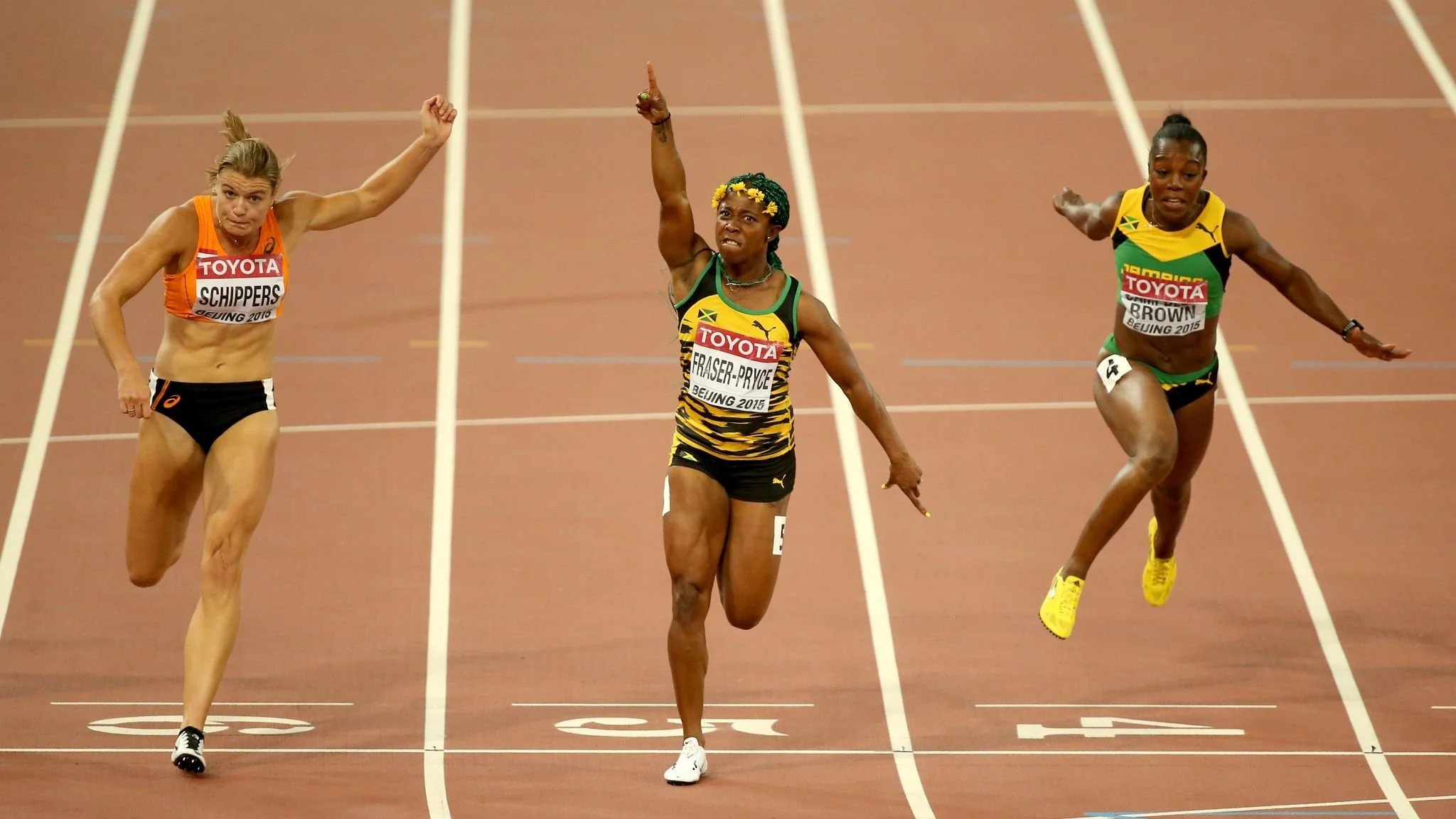
GLIDERS. On the other side of things are what we will call gliders, athletes that are not as fast twitch but have the gift of stiffness and elasticity. These are your natural 200/400 sprinters. They don’t have the most explosive start or a great standing vert or broad jump, but once they get moving they just effortlessly glide over the ground. These athletes may shock you with how well they can perform in competition right in the middle of doing lots of tough running in practice. They thrive on more mileage, because it maximizes their elastic talent. Their speed does not come from being highly fast twitch. The principles of managing training stress and recovery still apply of course. There still needs to be a balance of easy and hard days, but in general gliders respond much better to more work. As an example, a 20-minute jog on an easy day might be implemented for natural 400 runners, and they may like it, feel great, and perform their best while doing it. Whereas a fast twitch monster might hate jogging entirely, perform poorly when doing it, and quit the track team.
ENDURANCE RUNNERS. Athletes that excel in races 800 or longer are also gliders. In this group there are even more extreme examples of speed development from high running volume rather than high intensity. The common example is a great 800/1500m runner that drops down and runs a fast 400 or 200. For a coach with a “train fast to be fast” philosophy, this can be puzzling considering how the runner trains. We can make sense of it by understanding the difference between fast twitch talent and elastic talent.
FEMALES. Some research indicates that females have slightly fewer fast twitch fibers than males on average. I hypothesize that as part of this, the athletes on the extreme fast twitch end of the spectrum are mostly males. This is based purely on my limited observation. There are of course females with great explosive talent, but I have not worked with any who responded to low training stress and 4-5 days off per week like a fast twitch male. It seems they require more stimulation to perform their best. If my observation holds true generally, it could be related to a difference in fiber types as well as other factors.
This is not an excuse to run female athletes into the ground. It would just shift the balance slightly in the direction of more work. An example would be just using more easy days vs off days when it comes time to promote freshness and peak performance. This applies to explosive females as well as male gliders compared to fast twitch monsters.
HIGH RUNNING VOLUME?
It should be clear I am not suggesting we do away with running a lot. In fact, when considering some claims made about speed development using a minimalistic approach, I have actually advocated for higher volume training. It would be amazing if we could all get super fast by just sprinting 40m x4, but that is fantasy. That approach only produces results in certain situations for a short time.
I’m a big believer in some level of running volume. The key distinction is this: I think the benefit is more from accumulating elastic foot contacts than it is from training energy systems. People use the phrase “building a base.” I think the key component for speed development is an elastic base, not an aerobic base.